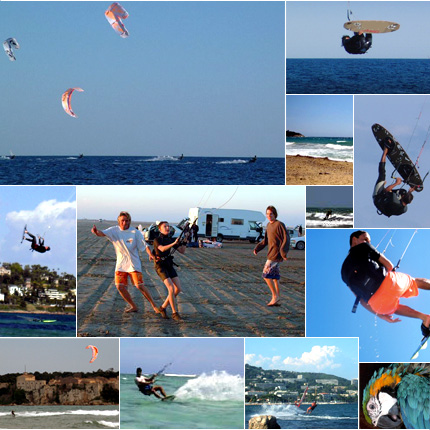
La Table suivante décrit les standards de la formation IKO.
Ils ont été réalisés pour valider le niveau des Kiters, depuis leurs premiers body-drags jusqu’à leurs premiers sauts.
Ils permettent à une personne de connaître son niveau, que ce soit pour une location, un achat de matériel, ou tout simplement pour
sa pratique personnelle.
Nous remerçions l’IKO d’avoir défini
ces niveaux, et engageons le plus de personne possible à les suivre.
L’association
PBKS, pour soutenir cette initiative, organise des journées de validations de
niveau, qui permettent d’acquérir la carte IKO, et ainsi de certifier son
niveau dans le monde entier.
Kiteboarding level up to level 1
Level
2 & 4 lines training
4 lines additional items
A
Equipment carrying
& setup (inflate bladders, untangle bridles, and connect leading
and flying lines).
Determine wind
direction.
Know how the safety
systems work (let go of the bar for 2 lines). The kiteboarder
knows that the kite leash must always be connected before launching
and until after landing.
Piloting at the top
of the window with short & long lines underpowered.
Piloting a kite
from right to left on the edge of the window.
Incident simulation
1.
Using of the safety
systems (dropping bar).
Rigging four-line
kite.
Piloting unhooked
B
Launching &
landing at the edge of the window with an assistant.
Piloting in the power
zone under powered
Untwisting the
lines by twirling the control bar without releasing it (the kiteboarder turns upon himself, bar in his hands
above his head)
C
Independent in
conducting a thorough pre- flight check
Know the wind window
key words (top, edge or neutral zone, clock wise 9, 12, 3 o'clock, power area)
D
Landing the kite
alone and walking to the kite
Body dragging
without a harness
Piloting in the
power zone
Untwisting lines by
rotating the body in the water.
Piloting with a
harness.
E
Use of quick
release on harness line or across the leader lines to stop the kite
power in case of emergency
Piloting with one
hand
On-shore self
launch
Relaunching the kite from the
water
Winding the lines
in the water, and come back to the shore using the kite to be dragged
Awareness of the
wind effects and their dangers (cliffs, mountains, hills, dikes,
trees…).
Managing to reduce
the power using the power loop.
Kiteboarder knows how the
power loop release system works and when to use it.
Kiteboarder level 1
Setting-up - Piloting - Safety - Managing of the practice area - Spot
analysis
Kiteboarding level up to level 2
Level
2 & 4 lines training
4 lines additional items
F
Incident simulation
2. Using the quick release (piloting while body is faced backwards.
Incident simulation
Using of the power loop release system.
G
Body dragging using
body positioning and piloting of the kite to move in wanted direction
(once to the left, then to the right)
Awareness of
positioning in space (starting point, arrival point)
Piloting one hand
while body dragging & piloting in waiting position legs down to
the wind.
4 line kite big
size relaunch
(Pulling on front line then back and front on one side).
H
Board recovering
and positioning of the feet into foot straps
Generating steady
pull in starting position on the board.
I
Water start
Tying the board
leash alone
First ride.
Kiteboarder level 2
Water start - Managing the kite's power - Edging.
Kiteboarding level up to level 3
Level
2 & 4 lines training
4 lines additional items
J
Priority rule 1: Two
riders going in front of each other, the rider starboard has the
priority he pilots his kite up. Port rider (kite on his left side)
goes down to the other rider and drops his kite.
Priority rule 2:
Incoming kiter gives way to outgoing kiter
Flying the kite to
generate steady pull once standing on the board.
Navigation with
power.
K
Change of direction
up and down to the wind (edging up and down).
Holding an edge
with the board.
Choosing the right
kite size.
Methods of flying
to de-power the kite (theoretical course about edge control).
Speed control,
sheeting in or out
Power trim
adjustment.
L
Up wind riding
(edging up while moving the kite down to slow down, edging down and
moving kite up to increase the speed)
Knowledge about
where to focus to keep the right course…
Up wind body
dragging to recover board without leash
M
Riding a twin-tip
or a wake board
Switch of direction
or Jibe with a directional board
N
First jump
(piloting the kite from one side to 12
o'clock).
Kiteboarder level 3
Riding powered - Going Up-wind -Switch of Direction - First Jump
Liens :IKO - International KiteboardingAssociation